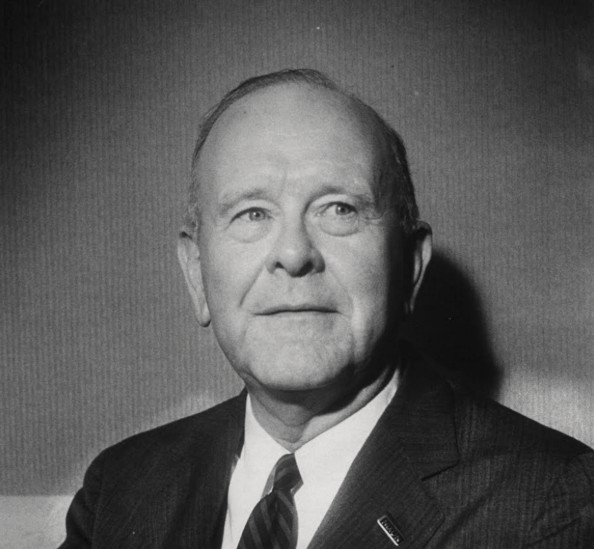
This is the third in an occasional Zealous series exploring major legal philosophers, with the aim of demonstrating why their ideas should matter to anyone who currently practices law. The previous entry on H.L.A. Hart ended with a teaser for a true clash of titans: before Dworkin picked up the gauntlet, Hart faced an earlier challenger who insisted that law, by its very nature, embodies a morality of its own. That challenger was Lon Fuller.
Lon Luvois Fuller (1902-1978) came out of Stanford with a law degree and never stopped working both sides of the line between theory and practice. He taught contracts at Oregon, then at Duke (where a young Richard Nixon sat in his class), and in 1940 joined the Harvard Law School faculty, eventually holding the Carter Chair of Jurisprudence until he retired in 1972. But Fuller was never an isolated academic. While teaching at Harvard, he simultaneously practiced as a labor lawyer at Ropes, Gray, Best, Coolidge & Rugg in Boston, and served for years as a labor arbitrator, including a five-year stint with Bethlehem Steel. His contracts casebook drew on that experience. He knew what it felt like to sit across the table from a counterparty, to advocate for your client's position and cause with zeal and skill.
That real practice background shaped everything Fuller thought about the law. Hart and Dworkin were preoccupied with judges deciding hard cases. Fuller was preoccupied with the rest of us. He saw lawyers not just as officers of the court, but as what he called "architects of social structure": the people who design contracts, build institutions, and create the frameworks within which human beings actually cooperate. He coined a term for this work: "eunomics," the study of good order and workable social arrangements.