
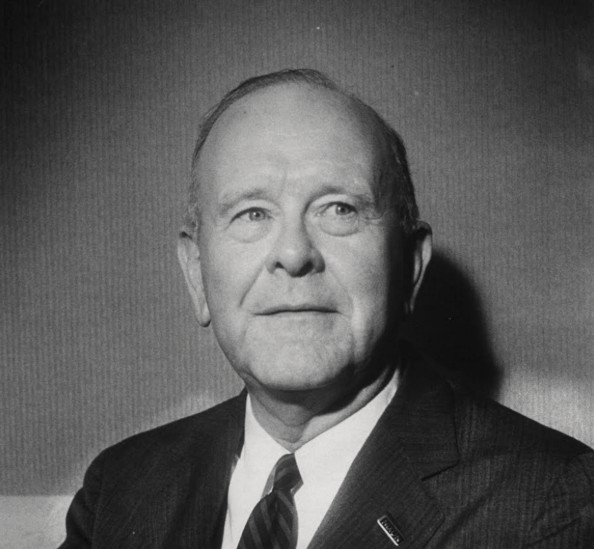
This is the third in an occasional Zealous series exploring major legal philosophers, with the aim of demonstrating why their ideas should matter to anyone who currently practices law. The previous entry on H.L.A. Hart ended with a teaser for a true clash of titans: before Dworkin picked up the gauntlet, Hart faced an earlier challenger who insisted that law, by its very nature, embodies a morality of its own. That challenger was Lon Fuller.
Lon Luvois Fuller (1902-1978) came out of Stanford with a law degree and never stopped working both sides of the line between theory and practice. He taught contracts at Oregon, then at Duke (where a young Richard Nixon sat in his class), and in 1940 joined the Harvard Law School faculty, eventually holding the Carter Chair of Jurisprudence until he retired in 1972. But Fuller was never an isolated academic. While teaching at Harvard, he simultaneously practiced as a labor lawyer at Ropes, Gray, Best, Coolidge & Rugg in Boston, and served for years as a labor arbitrator, including a five-year stint with Bethlehem Steel. His contracts casebook drew on that experience. He knew what it felt like to sit across the table from a counterparty, to advocate for your client's position and cause with zeal and skill.
That real practice background shaped everything Fuller thought about the law. Hart and Dworkin were preoccupied with judges deciding hard cases. Fuller was preoccupied with the rest of us. He saw lawyers not just as officers of the court, but as what he called "architects of social structure": the people who design contracts, build institutions, and create the frameworks within which human beings actually cooperate. He coined a term for this work: "eunomics," the study of good order and workable social arrangements.
But Fuller's most important and most contested contribution came in The Morality of Law (1964). His core thesis: law has an "inner morality," and a system that fails to meet it doesn't merely produce bad law. It fails to produce law at all.
He illustrated the point with a parable. Imagine a king named Rex who comes to the throne eager to be remembered as a great lawgiver. Rex sets out to create a legal system and fails spectacularly, in eight distinct ways. First, he fails to create rules of any generality, deciding every dispute ad hoc. Then he fails to publicize his rules, keeping them secret. He makes his rules retroactive, punishing people for conduct that was lawful when they did it. He drafts rules so vague no one can understand them. He enacts rules that contradict each other. He demands conduct that is impossible to perform. He changes the rules so frequently that no one can keep up. And finally, he administers the rules in ways that diverge wildly from what they actually say. Rex has failed eight times, and the result is not a bad legal system. It is no legal system at all.
Corresponding to Rex's eight failures, Fuller identified eight principles of legality: generality, promulgation, prospectivity, clarity, non-contradiction, possibility of compliance, constancy, and congruence between declared rules and official action. Together, these constitute the "inner morality of law." A system that substantially meets them has a moral claim on obedience. A system that systematically violates them forfeits the right to call itself law.
This was Fuller's direct challenge to Hart and to legal positivism generally. Positivists held that the validity of law depends on its social source, not its moral content. A statute enacted through proper procedures is law, even if it is evil. Fuller dissented. Certain moral requirements are baked into the very concept of law, and a regime that comprehensively violates them has produced something other than law, no matter how many times in history such regimes have arisen.
The confrontation had been building since 1958, when Hart delivered a lecture at Harvard titled "Positivism and the Separation of Law and Morals," published in the Harvard Law Review. Fuller's response, "Positivism and Fidelity to Law: A Reply to Professor Hart," appeared in the same volume. The two articles became, and remain, the standard scholarly reference point for the opposition between legal positivism and natural law theory.
At the center of the debate was a real case from post-war Germany. In 1944, a woman who wanted to rid herself of her husband reported to the Nazi authorities that he had made derogatory remarks about Hitler while home on leave from the army. The husband was convicted under Nazi statutes criminalizing statements harmful to the Third Reich, and sentenced to death (though the sentence was later commuted to service on the Eastern Front). After the war, the wife was prosecuted for illegally depriving her husband of his liberty by weaponizing the Nazi statute against him. Her defense: she had merely reported a violation of an existing law. The question for the court: was that Nazi statute valid law at all?
Hart and Fuller agreed that the wife should be punished. They disagreed about why, and the disagreement cuts to the core of what law is.
Hart said yes, the Nazi statute was technically valid law. Evil, but law. The wife did report a violation of an existing statute, and you cannot pretend otherwise just because the statute was monstrous. Post-war German courts were wrong to declare the Nazi statute "not a law."
Instead, Hart advocated for a new law to explicitly criminalize the conduct of people who weaponized Nazi statutes to persecute others. That law, Hart proposed, would be retroactive, punishing conduct that was technically legal when it occurred. Hart preferred that honest retroactivity to the fiction that the Nazi statute was somehow never law at all. At least retroactive punishment forces the legal system to confront the moral cost of what it is doing, rather than hiding behind a philosophical sleight of hand. By declaring the statute not law at all, Hart said, the courts took a shortcut that obscured the real moral dilemma.
Fuller's riposte:
I would like to ask the reader whether he can actually share Professor Hart's indignation that, in the perplexities of the postwar reconstruction, the German courts saw fit to declare this thing not a law.
....
To me there is nothing shocking in saying that a dictatorship which clothes itself with a tinsel of legal form can so far depart from the morality of order, from the inner morality of law itself, that it ceases to be a legal system.
To remedy the injustice produced by a regime that, among other horrors, imposed retroactive legislation, with yet more retroactive legislation, is a farce -- and implicates Fuller's own third principle of legality: prospectivity. Hart was asking the post-war legal system to commit the same category of sin that made the Nazi regime lawless in the first place. Fuller dismissed the proposal as merely restating "who should do the dirty work, the courts or the legislature."
His own answer required no retroactivity. A regime that systematically disregarded its own proclaimed rules, that habitually cured its legal irregularities by retroactive decrees, that used terror to escape even the pretense of legality, had forfeited the name of law. The Nazi statute was never law in the first place, so the wife had nothing to hide behind.
Hart struck back after The Morality of Law appeared. Fuller's eight principles, Hart argued, were principles of efficacy, not morality. They tell you how to make law that works, not law that is good. By Fuller's logic, Hart quipped, one could just as well speak of an "inner morality of poisoning." A poisoner who wants to poison effectively also needs principles: know your dosages, be consistent, don't mix in an antidote. Clarity, consistency, and stability are useful to tyrants and democrats alike. A regime could follow all eight of Fuller's principles perfectly and still be monstrous.
But poisoning is something you do to someone, replied Fuller. Law is something you do with someone. A legal system only works if citizens understand the rules and voluntarily conform their behavior to them. That relationship between ruler and ruled is inherently moral, Fuller argued, because it requires the government to treat citizens as rational agents capable of following rules, not as objects to be manipulated. A poisoner treats the victim as an object. A lawgiver who follows the eight principles must treat citizens as participants. The morality lives in that distinction.
Who has the better of it? This is a debate that has consumed jurisprudence scholars for nearly 70 years. Hart's The Concept of Law remains what his biographer Nicola Lacey called "the main point of reference for teaching analytical jurisprudence" worldwide.
But Fuller's eight principles have become the conceptual foundation of modern rule-of-law theory. The World Justice Project, which publishes the leading international rule-of-law index, measures countries against criteria that are, as the Harvard Law Review has put it, "Fullerian": whether laws are publicized, clear, stable, applied evenly, and actually enforced as written.
And this is where the architect of social structure pays homage to the eight principles. Fuller's inner morality of law is a description of what the transactional lawyer does every day. The architect of social structure drafts rules that are general enough to govern future conduct, clear enough for both parties to understand, free of contradiction, reasonable to perform, and stable enough to be relied upon and produce predicted results. When the architect fails at these, the structure collapses. The contract has, in Fuller's terms, failed to function as an operable binding instrument, devoid of force and morality. It has failed to do the thing that contracts exist to do: subject conduct to the governance of stable and predictable rules.
Fuller understood something that Hart and Dworkin missed. The law that governs most people's lives is not found in judicial opinions or legislative debates. It is found in the agreements that lawyers draft, the corporate structures they design, the compliance frameworks they build, the relationships they shape. The transactional lawyer is not the lesser cousin of the judge or the litigator -- the transactional lawyer is the primary architect of the legal order that people actually inhabit.
What does this mean for the modern legal practitioner? If the daily work of drafting and structuring and negotiating is itself a form of lawmaking, then the lawyer who does that work bears the same moral obligations that Fuller demanded of any lawgiver. The eight principles apply. Clarity is not optional. Consistency is imperative. The requirement that your rules be possible to obey is not a drafting preference. It is the minimum threshold of legitimacy.
Next in this series: Oliver Wendell Holmes Jr. "The life of the law has not been logic: it has been experience." The most quoted sentence in American jurisprudence, from a Civil War veteran who saw law not as a system of rules or moral principles but as a prediction of what courts will do in fact.


