
Legal AI provokes a crisis of confidence and a crisis of conscience at the same time, within the same lawyer. Its sometimes jaw-dropping power paradoxically instills an inchoate feeling of dread.
Feelings of guilt and concern over use of a tool that could very well reduce the need to hire associates and staff, or even the lawyer using it, has not truly been reckoned with. And yet, there's no turning back.
The capabilities of this technology in the legal space can be easily predicted - where it's heading seems obvious as its capabilities improve on an exponential basis. Lawyers are replaced by AI replicas. Then what? Court staff? Judges? What happens when the legal system is entirely composed of machines - no human input or even visibility?
Is this thing going to commoditize what we are and do? Must we bow to the inexorable logic of the tool and its ruthless efficiency?
The answer must be no. Only humans should be responsible and accountable for decisions impacting other humans. Machines cannot be allowed to replace lawyers, judges, legislators, and public servants.
Human lawyers are essential to a stable, ordered, civilized society structured by rules and ethics. The rules should be created, interpreted, enforced, negotiated, and made consequential solely by humans.
UN Basic Principles on the Role of Lawyers (1990). Fundamentally, human agency and dignity demands that humans alone should judge and deal with humans and their rights. We can't outsource the machinery of justice and its enabling profession, the engine of an ordered society, to a machine hosted on AWS or Google Cloud, powered by Palantir.[A]dequate protection of the human rights and fundamental freedoms to which all persons are entitled, be they economic, social and cultural, or civil and political, requires that all persons have effective access to legal services provided by an independent legal profession.
We should fight this to the last. Enforce unauthorized practice against the AI companies. If that means we go a little bit slower, more analog, more old school, that's a small price to pay. If that means laypeople are still better off not going pro se and instead hiring (or being appointed) a real lawyer to get the best representation they can, then so be it. That's a licensed fiduciary, bound by a code of ethics (vigorously enforced), and amply insured. Something an AI will never be.
There's a price to pay for safety, shared legitimacy, and authenticity - and ultimately, dignity. There's a price to pay to keep us in the loop at all times. It's not a lot. A loss of efficiency and speed. That's it. Some things are worth taking our time on.
A faceless, nameless, unaccountable machine should never have the ultimate power to dispense or organize justice.
AI played no part in the drafting of this post.
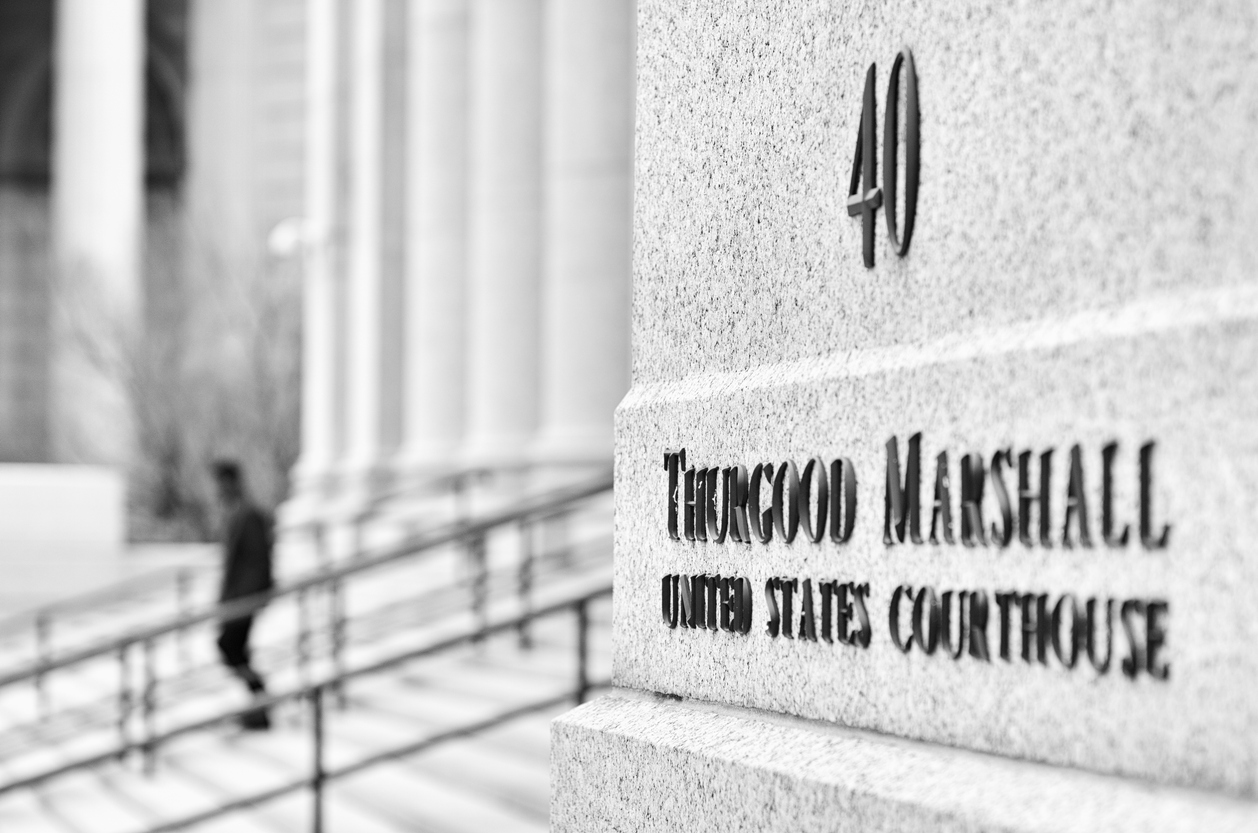
(Photo: Thurgood Marshall US Courthouse, NYC)


