
Forty percent of ABA-accredited law schools are in severe financial distress. Another 30% are in considerable difficulty. If you went to law school, there's a decent chance your alma mater is struggling to keep the lights on.
Paul Campos, a professor at the University of Colorado Law School who has been tracking law school economics with unusual candor for over a decade, just posted a data-heavy SSRN paper that puts hard numbers on the slow-motion collapse. As he describes it on his blog, what he calls "Peak Law School" hit in 2010, when total JD tuition revenue reached its all-time high. Since then, "JD tuition revenue is down 41% - 24% per capita, with the rest of the decline attributable to falling enrollment."
The culprit, in Campos's telling, is the three-decade pursuit of U.S. News rankings:
The numbers are grim across the board. Eleven ABA law schools have closed in the past decade - more than five percent of the total. Only one closed in the previous 50 years. Cooley Law School has eliminated 75% of its full-time faculty and is still losing money. UCLA's tenured and tenure-track law faculty averaged $407,000 in salary in 2024, roughly double what arts and sciences faculty earn at the same university.The transformation of law schools from cash cows, or at least self-funding enterprises, into economic basket cases is directly attributable to the malign effect of the US News law school rankings, that became an annual thing in 1990. Schools got rewarded in the rankings simply for spending more money, so you don't need to be a scientitian to figure out what happened next.
Campos doesn't pretend the pay gap is defensible. He just hopes it outlasts his career: "The notion that law professors need to be paid a lot more than professors in the humanities and social and physical sciences is an anachronistic remnant of a bygone era, and I'm hoping it disappears immediately after my retirement."
And it's about to get worse. Grad PLUS lending ended on July 1, with new professional-degree borrowers now capped at $50,000 per year and $200,000 total. Schools that were already bleeding revenue just lost the federal lending life preserver that kept many of them afloat.
Campos frames this as a story about institutions "quasi-bankrupting themselves in an almost wholly vain pursuit of a completely phony institutional prestige." But the pattern extends well beyond law schools. Any industry that builds its business model around a third-party ranking and unlimited access to borrowed money is heading for the same cliff.
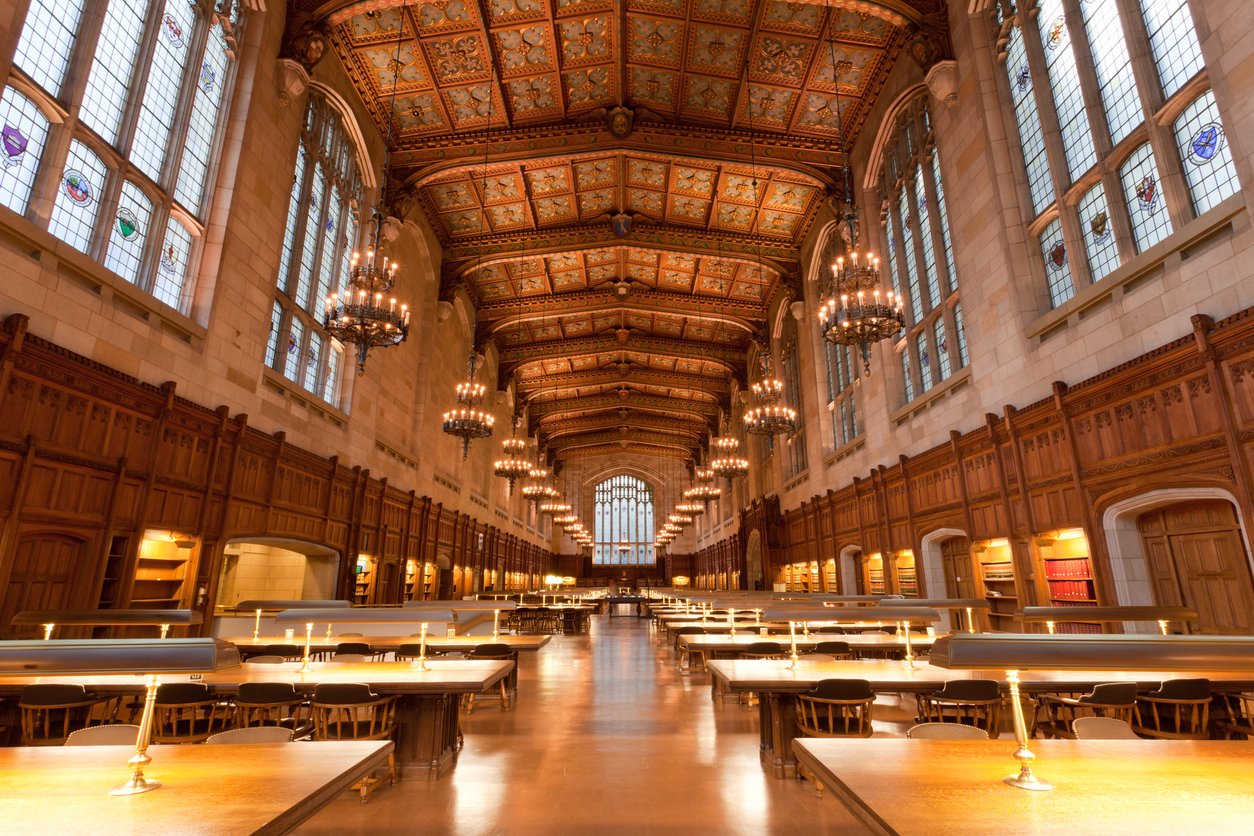
Photo: University of Michigan Law Library


