
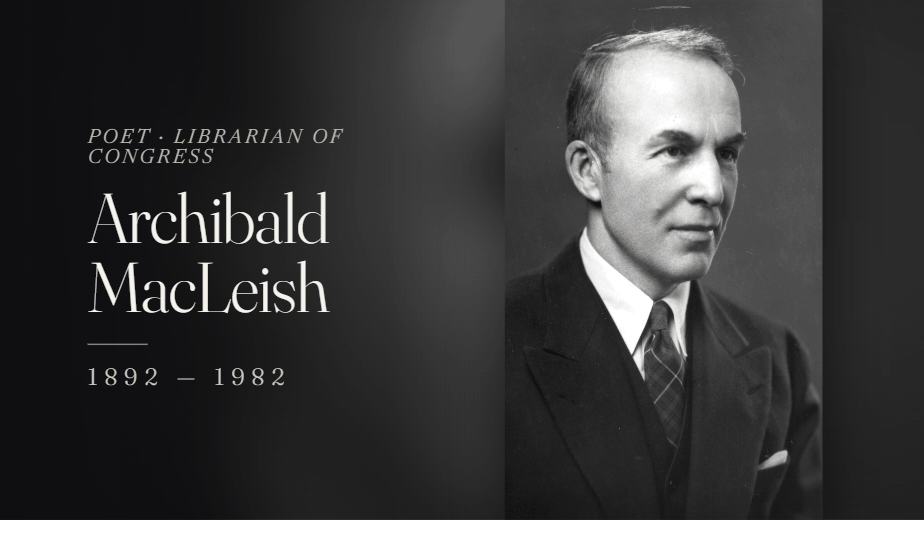
In 1923, a young Boston lawyer named Archibald MacLeish, who finished first in his class at Harvard Law, was made partner at his firm. He resigned the same day to move himself and his family to Paris.
This is why.
A poem should be palpable and mute
As a globed fruit,
Dumb
As old medallions to the thumb,
Silent as the sleeve-worn stone
Of casement ledges where the moss has grown—
A poem should be wordless
As the flight of birds.
A poem should be motionless in time
As the moon climbs,
Leaving, as the moon releases
Twig by twig the night-entangled trees,
Leaving, as the moon behind the winter leaves,
Memory by memory the mind—
A poem should be motionless in time
As the moon climbs.
A poem should be equal to:
Not true.
For all the history of grief
An empty doorway and a maple leaf.
For love
The leaning grasses and two lights above the sea—
A poem should not mean
But be.
The poem is "Ars Poetica," the art of poetry, written in 1926 during his Paris years. It became his best-known poem, its last two lines a manifesto of ars gratia artis (art for art's sake).
He spent the rest of his life proving otherwise. He came home in 1928, took a job writing for Henry Luce at Fortune, and began making poems that did nothing but have meaning: the Depression, Cortés and the conquest of Mexico in Conquistador, and the fascism gathering over Europe.
In 1939 Franklin Roosevelt made him Librarian of Congress, over loud objections that a poet had no business running the place and was probably a communist besides. MacLeish took it, overhauled the institution, built its poetry program, and set in motion what would become the US Poet Laureate.


